

Blog
COMPLETE GUIDE TO ELECTROSTATIC SEPARATION OF HASHISH
Principles of Electrostatic Fields and Their Application in Separation
5/21/20263 min read
As this technology continues to evolve, it is expected to largely replace conventional ice water and washing filtration methods, offering a cleaner, more efficient, and more reproducible alternative for obtaining high-quality hashish.
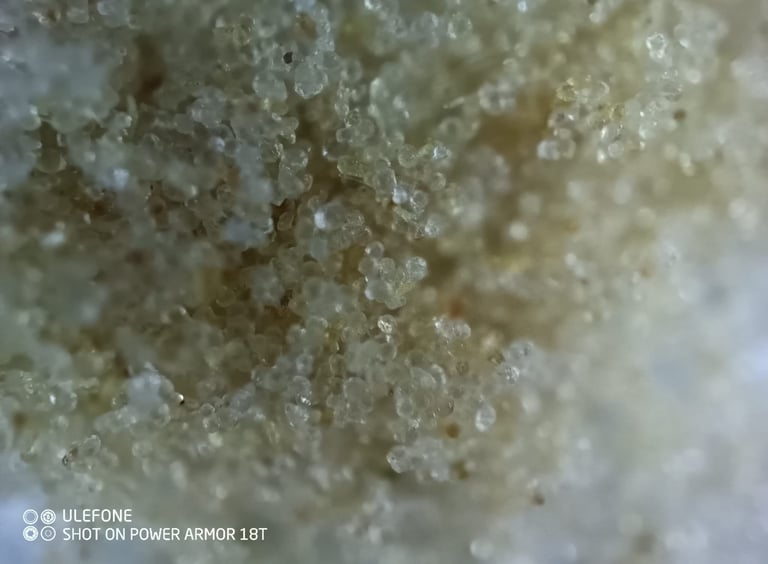
In recent years, the hashish industry has been exploring new technologies to improve the purity and efficiency of extraction processes. Among them, electrostatic separation has proven to be one of the most innovative and effective options. This method is based on the use of electrical charges to differentiate and isolate trichome heads from the remaining plant material, preserving cannabinoids and terpenes to the greatest extent possible.
The principle of electrostatic separation has ancient roots, with documented applications for centuries in industries such as mining and material sorting. However, its application in hashish production is relatively recent. In the past, rudimentary techniques based on static electricity were used, such as those described by Robert Clarke in Hashish!, where a 1970s device called “The Original Astounder” was mentioned. Today, technological advances have enabled the development of automated systems capable of achieving trichome concentrations with purity exceeding 95%.
The reasons why this method is gaining ground include:
Lower environmental impact, as it requires no water or solvents and consumes little energy.
Maximum efficiency, allowing large volumes to be processed in less time.
Higher purity results, with a significant reduction in plant material contamination.
Preservation of the terpene profile, avoiding degradation caused by more aggressive methods.
Scalability and ease of implementation, adapting to different production levels.
Fewer regulatory requirements, as in some jurisdictions it is not considered a solvent-based extraction process.
Principles of Electrostatic Fields and Their Application in Separation
To understand how this process works, it is essential to know how electric fields interact with charged particles.
There are several basic configurations that generate an electric field in an electrostatic separator:
Single charged plate: produces an electric field perpendicular to its surface, attracting or repelling particles depending on their charge.
Parallel plates: create a uniform field that directs charged particles in a predictable manner.
Non-parallel plates: generate a variable field, affecting particle trajectories depending on charge and spatial position.
The behavior of particles within this field depends on several factors:
Electric field intensity, which influences the force with which particles are attracted or repelled.
Initial velocity and direction of movement, as higher inertia particles may deviate before being separated.
Net particle charge, which determines whether it is attracted to the positive or negative plate.
Particle size and shape, with spherical particles being easier to charge and separate than irregular or elongated ones.
Design of an Electrostatic Separator for Hashish
For this process to work optimally, the separator design must meet certain technical requirements.
Material Feeding System
Hashish must be introduced into the separator in a controlled manner, ensuring a homogeneous distribution of particles in the separation chamber. This can be achieved through:
Rotating drum, which releases the material uniformly.
Vibrating sieves, which help distribute particles according to size.
Air suction or pressure systems, which transport the material into the separator without affecting its electrical charge.
Airflow Control
One of the most important aspects of electrostatic separation is maintaining laminar airflow. Turbulent flow can cause uncharged particles to adhere to unwanted surfaces, reducing efficiency. To avoid this, closed chambers are designed with strategically placed air outlets and smooth internal surfaces without turbulence-inducing edges.
Particle Charging Methods
For hashish particles to be separated, they must first be electrically charged. The most effective methods include:
Triboelectric charging, generated by friction with materials such as Teflon, PVC, or silicone.
Triboelectric cyclone, which also classifies particles by density while charging them.
Spiral tubes, used in some commercial separators to optimize particle charging before separation.
Electrostatic Plate Characteristics
The size and arrangement of the plates directly affect separator efficiency.
In general, they should be significantly larger than the distance between them.
There are two approaches to plate use:
Direct capture, where particles adhere to the charged plate.
Particle redirection, where the electric field diverts particles into collection chambers.
Regarding plate materials, tests have been carried out with stainless steel variants 304, 316, and 430, yielding good results. However, the best results have been achieved with very thin anodized aluminum, as it improves particle charging efficiency and optimizes separation.
Key Factors for Optimal Refinement
The success of this method depends both on the characteristics of the input material and environmental conditions.
Hashish Characteristics
For efficient separation, hashish must meet certain criteria:
Low moisture (below 0.6 AW) to prevent clumping and facilitate electrostatic charging.
Sufficient electrical charge so particles respond properly to the electric field.
Homogeneous size, ideally between 70 and 150 µm, to minimize unwanted effects.
Spherical shape, as round trichomes charge and separate better than irregular fragments.
Optimal Environmental Conditions
Air humidity between 25–40% RH to avoid uncontrolled electrostatic discharges.
Controlled airflow to maintain correct particle direction.
Stable atmospheric pressure, reducing the possibility of plasma formation.
Constant temperature, avoiding alterations in material consistency.
Conclusion
Electrostatic separation is revolutionizing hashish production, enabling purity levels above 75% in a single pass. By optimizing charging parameters, airflow, and separator design, significantly better results can be achieved compared to traditional extraction methods.