

Blog
ELECTROSTATIC SEPARATION OF PLANT TRICHOMES: PHYSICAL FUNDAMENTALS AND DIRECT APPLICATIONS IN BOTANY
ELECTROSTATICS APPLIED TO CANNABIS
C-Days
El evento de referencia del CannabisHUB.
BizKaia Aretoa
Universidad del país Vasco
16th. April 2026 BILBAO
C-TALKS
Ponencia
DAVID ARANSAY ESTEVE / CEO ION+Industries
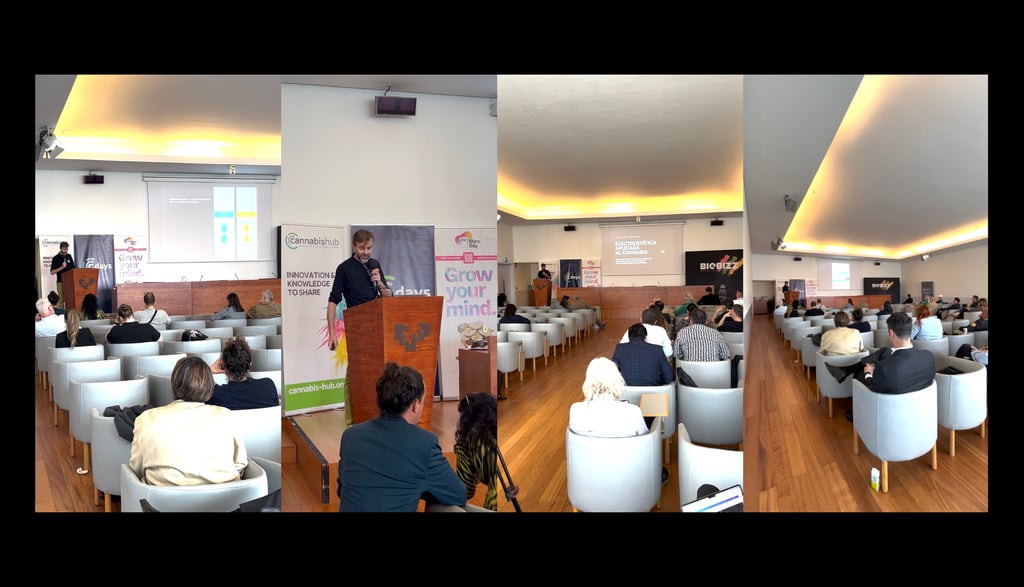
In recent years, the cannabis industry has undergone a very significant evolution in its extraction and refinement methods. We have moved from completely artisanal processes to increasingly technified systems, with greater control and production capacity.
However, if we analyze the foundations of these processes in depth, we observe that most still depend on mechanical principles such as friction, vibration, or size-based classification. These methods have been essential for the development of the sector and still have their place. But they also present limitations when we aim for higher levels of purity, control, and scalability.
That is why today I propose a different approach: the application of electrostatics as a selective separation tool… based not on mechanical action, but on the physical behavior of particles within a controlled electric field.
Limitations of traditional methods
To understand the value of this approach, it is important to analyze how the most widely used methods currently work.
Systems such as dry sieving, tumblers, vibration, or micron-based classification allow material to be organized according to size or mechanical behavior.
This is useful… especially in the initial phases of the process.
But they present an important limitation:
They do not truly separate by purity… but by physical similarity.
In practice, a trichome head and a fine plant fragment can have similar sizes… and pass through the same mesh, ending up in the same fraction.
In addition, when the process is prolonged or the level of manipulation increases, friction can generate finer plant particles… increasing contamination.
Another key factor is operator dependence. Variables such as time, intensity, or working method directly affect the result, making reproducibility difficult.
Therefore, the current challenge is not only extraction or classification… but precise, controlled, and reproducible separation.
Importance of trichomes
Glandular trichomes are the most valuable part of the plant.
They concentrate cannabinoids, terpenes, and other active compounds.
However, the material obtained after an initial process is not homogeneous.
Within it we find: whole trichome heads… trichome fragments… fine plant matter… and structural residues.
Many of these particles may have similar sizes… but not the same value.
Therefore, the real challenge is not only collecting trichomes… but isolating glandular heads with the highest possible purity.
Principle of electrostatics
Electrostatics is based on a known physical principle: different materials acquire and respond differently to an electric charge.
When we apply a controlled electrostatic field: particles become differently charged… and respond differently within that field.
Some are attracted to one pole… others to the opposite one.
The key point is that this behavior does not depend only on size… but also on properties such as composition, structure, or surface characteristics of the particle.
This introduces a new separation variable: not only size… but physical response within an electric field.
Physical basis of separation
The core of the process is that not all particles respond equally to an electric field.
Trichome heads and plant matter present differences in composition, structure, and surface properties.
These differences cause them to acquire and retain charges differently… and to behave differently within the system.
This response is not random. It is consistent and repeatable under controlled conditions.
Factors such as humidity, density, morphology, or composition influence behavior… so environmental control is essential.
As a result, different fractions move toward distinct zones within the system… enabling a more precise separation than one based solely on size or weight.
Scientific rigor in process definition
In the development of new technologies within this industry, it is essential to work with well-defined physical principles and measurable processes.
Electrostatics is a widely studied field, with known models and predictable behavior when operated under controlled conditions.
This allows the design of stable, adjustable, and reproducible systems.
Technological progress is not only about the final result… but about the ability to understand, control, and reliably repeat the process.
Separation without heat or pressure
When we talk about working without heat and without pressure, it is important to clarify the meaning.
In many mechanical processes, even without an external heat source, friction itself—through vibration, rubbing, or material accumulation—generates a slight temperature increase.
When working with volatile compounds such as terpenes… this thermal increase can modify their behavior and promote evaporation, even progressively.
On the other hand, pressure is not always direct.
There is constant mechanical interaction: contact, accumulation, manipulation…
This can deform particles and encourage unwanted mixing.
Electrostatics minimizes these variables.
It does not push… it does not compress… it does not rub.
It simply separates according to the physical behavior of each particle within a controlled electric field.
Advantages of electrostatics
This approach offers several key advantages.
In mechanical processes, separation usually involves friction.
This friction generates a triboelectric effect and, associated with it, a temperature increase, even if slight.
When working with volatile compounds such as terpenes… this thermal increase can promote evaporation or reduce their content, especially in prolonged processes.
Therefore, the mechanical nature of the process can partially affect the terpene profile.
Electrostatics, by not relying on mechanical friction… reduces this effect and allows work under more stable conditions for material preservation.
Additionally: it increases precision… reduces plant contaminants… and improves reproducibility.
And very importantly… it enables true scalability of the process.
A manual process can be excellent at small scale… but it is limited by time, fatigue, and human variability.
A machine-based system can operate continuously… maintaining stable conditions and consistent results.
This transforms a craft process… into a real industrial process.
Practical application
In a real process, the previously processed material is introduced into the system.
A controlled electrostatic field is generated… adjusted to the characteristics of the material.
From that moment, particles begin to behave differently… and gradually separate within the system.
This process occurs without pressure… without aggressive friction… and with minimal handling.
The result is a differentiated collection of fractions… allowing greater control over final quality.
Industry impact
Electrostatics introduces a relevant shift in approach.
We move from systems mainly based on mechanics… to systems based on applied physical principles.
This improves standardization… increases batch-to-batch consistency… and optimizes product quality.
It also facilitates industrial scalability without losing precision.
Conclusion
Electrostatics does not replace existing methods…
but adds an additional layer of control and selectivity.
It allows separation not only by size…